Checklist for New Moms Stay Guarded with the Baby
Use this checklist for new moms stay guarded with the baby through safer sleep, hygiene, visitors, outings, emergencies, and daily care.
In this article
- 1. Safe Sleep Environment (ABCs of Safe Sleep)
- Make the Transfer Part of Feeding
- 2. Properly Installed Car Seat
- Rear-Facing and Harness Details That Matter
- 3. Bath and Water Safety
- Build a Water Watcher Habit
- 4. Choking Hazard Prevention
- Check the Objects Adults Handle Without Thinking
- 5. Fall and Furniture Safety
- Anchor, Gate, and Lower Before Each New Skill
- 6. Poison and Medication Storage
- Products That Deserve Extra Respect
- 7. Fire, Burn, and Hot-Liquid Safety
- Separate Hot Liquids From Baby Handling
- 7-Point Newborn Safety Checklist Comparison
- Make Safety a Shared Responsibility
- Set Visitor Rules Before Anyone Arrives
- Plan for Fatigue and Escalate Early
You're home, sleep-deprived, and the baby is finally quiet in your arms. Then the doorbell rings, your phone buzzes, hot water is running for a bath, and a well-meaning visitor reaches in for a hold. Nothing here is unusual, and that's exactly why it matters. Most newborn safety failures don't happen during dramatic moments. They happen when a tired parent tries to do three ordinary things at once.
The first month deserves extra structure. In WHO's overview of newborn mortality, approximately 2.3 million children died during their first 28 days in 2022, and newborn deaths represented roughly 47% of deaths among children younger than five. About one-third of neonatal deaths occur during the first 24 hours, and nearly three-quarters occur during the first seven days. That concentration of risk is why close observation, feeding and temperature checks, prompt follow-up, and fast escalation for breathing trouble or unusual lethargy matter so early.
This checklist for new moms to stay guarded with the baby works best as a repeatable system, not a poster you read once. Set up the safest default in each room, save emergency numbers where every caregiver can find them, and agree in advance who holds the baby, who answers the door, and who takes the next sleep shift. When the safe choice is already prepared, you don't have to invent it at 3 a.m.
1. Safe Sleep Environment (ABCs of Safe Sleep)
Place your baby Alone, on the Back, in a Crib or other approved sleep surface for every nap and every night. That's the AAP's ABCs, and it's the single most repeatable habit on this list. The surface should be firm, flat, and separate from your bed, with only a fitted sheet. No pillows, loose blankets, bumper pads, inclined sleepers, sleep positioners, or soft toys belong in that space.

Sleep-related risk stays preventable only if the setup stays boring and consistent. The CDC feature on helping babies sleep safely reports approximately 3,700 sleep-related infant deaths in 2022, while its review of reported practices found 22% of mothers didn't routinely use back positioning, 61% reported bed-sharing, and 39% reported soft bedding. Guidance in that same feature notes that room-sharing without bed-sharing, ideally for at least six months, may reduce SIDS risk by as much as 50% compared with a separate room.
Make the Transfer Part of Feeding
Feeding and rocking to sleep are normal, so plan for them instead of pretending they won't happen. A 2024 AAP-published study of safe sleep tension in real routines found 80% of participating mothers held or rocked infants to sleep and 76% fed infants to sleep. After feeding or soothing, move your baby to the separate crib or bassinet before you sleep. If you're getting drowsy, sit upright, turn on a light, or hand the baby to an awake adult.
- Check mattress fit: Leave no gap larger than two fingers between mattress and crib side.
- Check recalls first: Verify cribs, bassinets, and play yards against the CPSC recall listings before use.
- Never use sofas for sleep: Couches, armchairs, adult beds, and waterbeds are high-risk fallback spots, especially when you're exhausted.
Practical rule: If your eyes are closing, the baby goes into the bare crib even if she wakes during the transfer. A brief cry is safer than accidental sleep together on a couch.
Hospitals with bare crib policies model this well at discharge. Copy that standard at home, and repeat the same visual check every time. Position, surface, surroundings. That's the whole scan.
2. Properly Installed Car Seat
Bringing a baby home in a car seat you've never installed before is a predictable stress point, and it's avoidable. Install the seat weeks ahead, read both the car seat manual and your vehicle manual, and practice tightening the harness on a doll or rolled towel. A seat can look secure and still move too much at the belt path, sit at the wrong recline angle, or have harness straps routed incorrectly.
Get a professional check before the due date if you can. Many hospitals, fire departments, and community programs host inspection events where a certified Child Passenger Safety Technician reviews the installation free of charge. You can find technicians through Safe Kids Worldwide or the NHTSA locator tool. Bring the manuals, and ask the technician to watch you reinstall the seat yourself. Watching someone else do it perfectly doesn't teach your hands the job.
For a visual walkthrough of basic installation checks, watch this demonstration before your own inspection appointment.
Rear-Facing and Harness Details That Matter
Keep your child rear-facing for as long as possible, until reaching the highest weight or height your seat allows. That's the shared recommendation from the NHTSA and the AAP, and it applies well beyond the newborn stage. Use either the LATCH system or the vehicle seat belt to install, never both unless both manuals explicitly permit it. Never place a rear-facing seat in front of an active airbag.
- Remove bulky coats: Puffy layers compress in a crash and loosen the harness. Buckle first, then place a blanket over the harness.
- Retire crashed seats: Replace any seat involved in a moderate or severe crash, even if damage isn't visible.
- Skip loose add-ons: Avoid inserts, strap covers, or toys that didn't come with the seat unless the manufacturer approves them.
On outings, treat the car seat as travel equipment, not a portable bed. Once you're home, move a sleeping baby to the flat crib or bassinet. That one transfer habit connects car safety back to safe sleep instead of undermining it.
3. Bath and Water Safety
Bath time fails on logistics more often than on knowledge. Parents know not to leave a baby alone in water, but the towel is in the hallway, the clean diaper is in the nursery, and the doorbell rings. Solve that before water touches skin. Set out the towel, diaper, clothes, washcloth, and soap within arm's reach, silence your phone, and treat the next few minutes as a closed task.
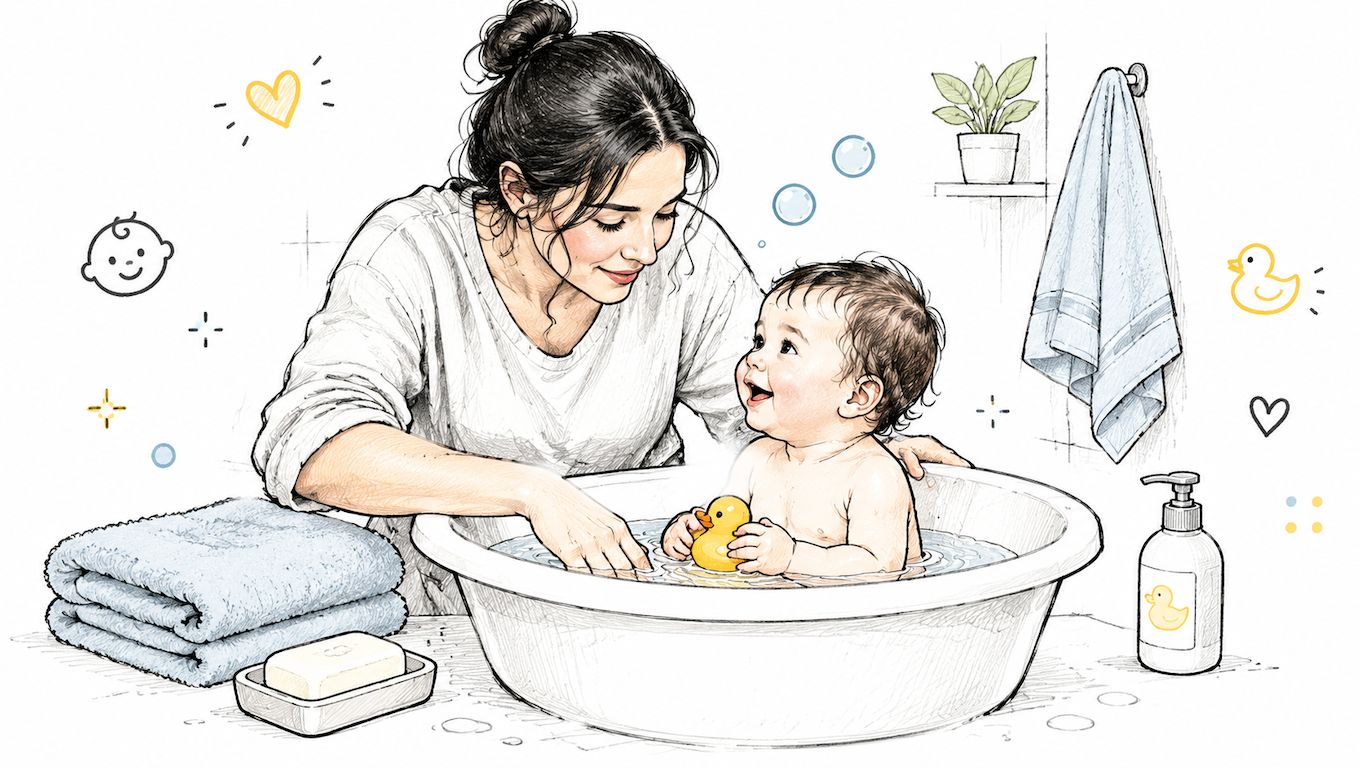
Babies can drown quickly in very small amounts of water, including bathtubs, buckets, and toilets. Constant hands-on supervision is the protection, not a bath seat, ring, or inflatable support. Those products can tip or create false confidence, and they don't watch the baby for you. If you must step away, wrap your baby in the towel and take her with you. A wet, annoyed baby in your arms is the correct outcome.
Build a Water Watcher Habit
Drowning prevention campaigns from Safe Kids Worldwide and the CDC use the idea of a designated Water Watcher, one adult giving undivided attention during water play. Apply the same single-owner rule at bath time and later at pools. If another adult takes over, make the handoff explicit and verbal. Assumed supervision is where gaps open.
Sponge baths are the usual starting point until the umbilical cord stump falls off, which keeps early baths simple and controlled. After each bath, empty the tub immediately and store it upright or out of reach so it can't collect water later. Apply the same empty-and-store rule to buckets, basins, and pet bowls once your baby starts moving toward objects independently.
If it holds water and sits at baby level, empty it, flip it, or put it behind a closed door. Storage is supervision that keeps working when you leave the room.
Test water temperature carefully before your baby goes in, and keep one hand supporting her throughout. Slippery skin, a sudden startle, and a hard faucet are a bad combination, so slow movements and a secure hold matter as much as water depth.
4. Choking Hazard Prevention
A newborn doesn't reach for much yet, which gives you a short window to fix the floor before she does. Use it. Babies explore by mouthing objects once grasping starts, and small household items migrate constantly. Coins fall from pockets, older siblings drop game pieces, visitors leave bags open, and remote controls shed battery covers. Choking prevention is mostly routine housekeeping done at baby height.
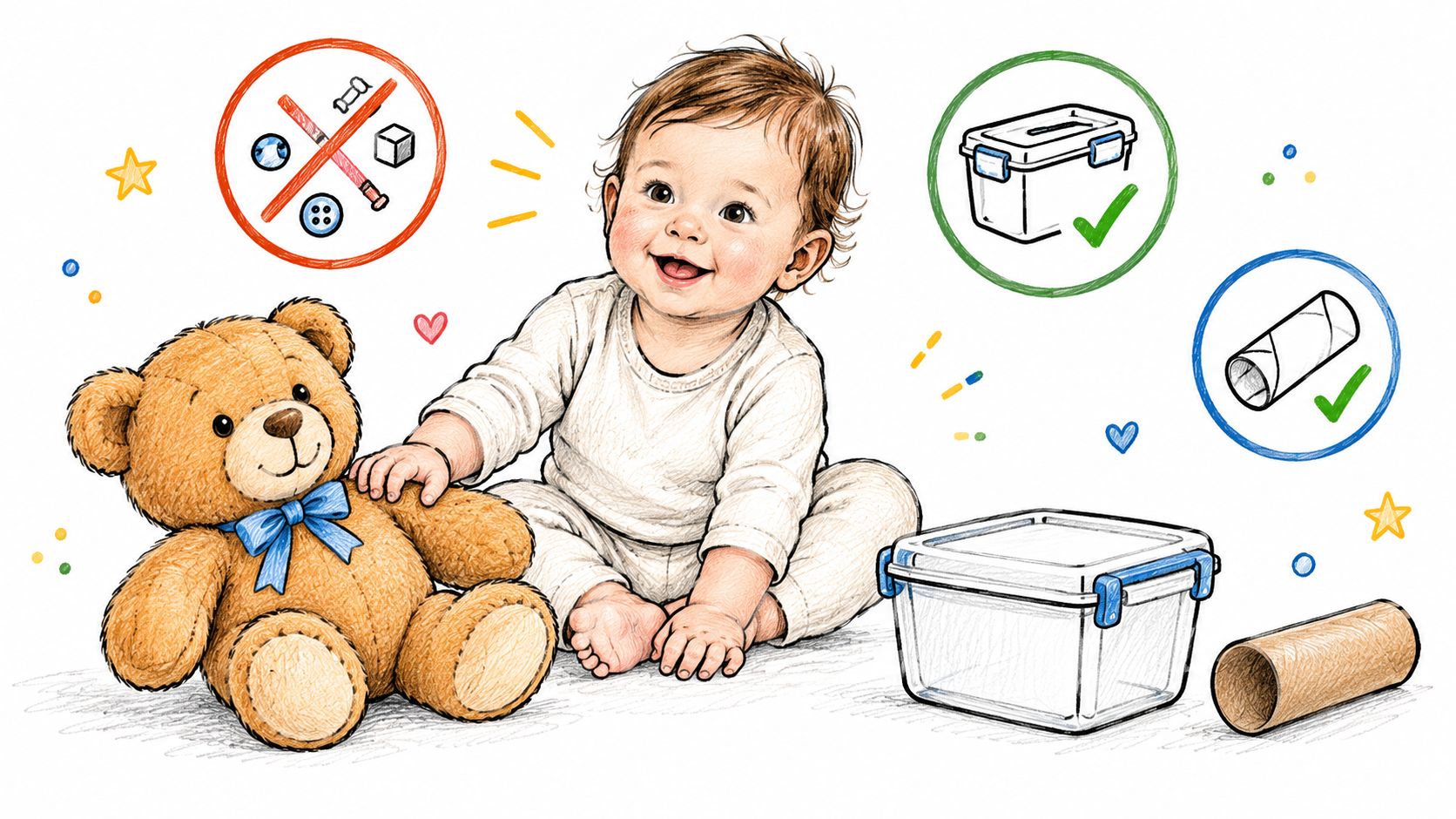
Get down on the floor and crawl the rooms where your baby will play. You'll see hazards you'd never notice standing up. Run the toilet paper tube test on toys and loose objects, since items that fit through easily deserve removal from baby spaces. Pay particular attention to button batteries and small magnets, which appear repeatedly in CPSC toy recall cases because swallowing them can cause severe internal injury, not just airway blockage.
Check the Objects Adults Handle Without Thinking
- Secure battery covers: Check remotes, key fobs, musical cards, flameless candles, and light-up toys, then tape or replace anything loose.
- Park bags up high: Purses and diaper bags hold coins, mints, medication, and hair ties, so hang them instead of dropping them by the sofa.
- Inspect toys weekly: Discard cracked plastic, loose eyes on stuffed animals, and broken parts before they detach in a mouth.
- Supervise every meal later: When solids begin, cut food into small, soft, developmentally appropriate pieces and keep your baby seated and watched.
Preparation also means knowing what to do before you need it. Take an infant CPR and first aid course through an organization such as the Red Cross, and practice back blows and chest thrusts on a training manikin until the sequence feels physical, not theoretical. Keep local emergency numbers visible for grandparents and sitters too. Under stress, nobody should be searching a phone for information that belongs on the fridge.
5. Fall and Furniture Safety
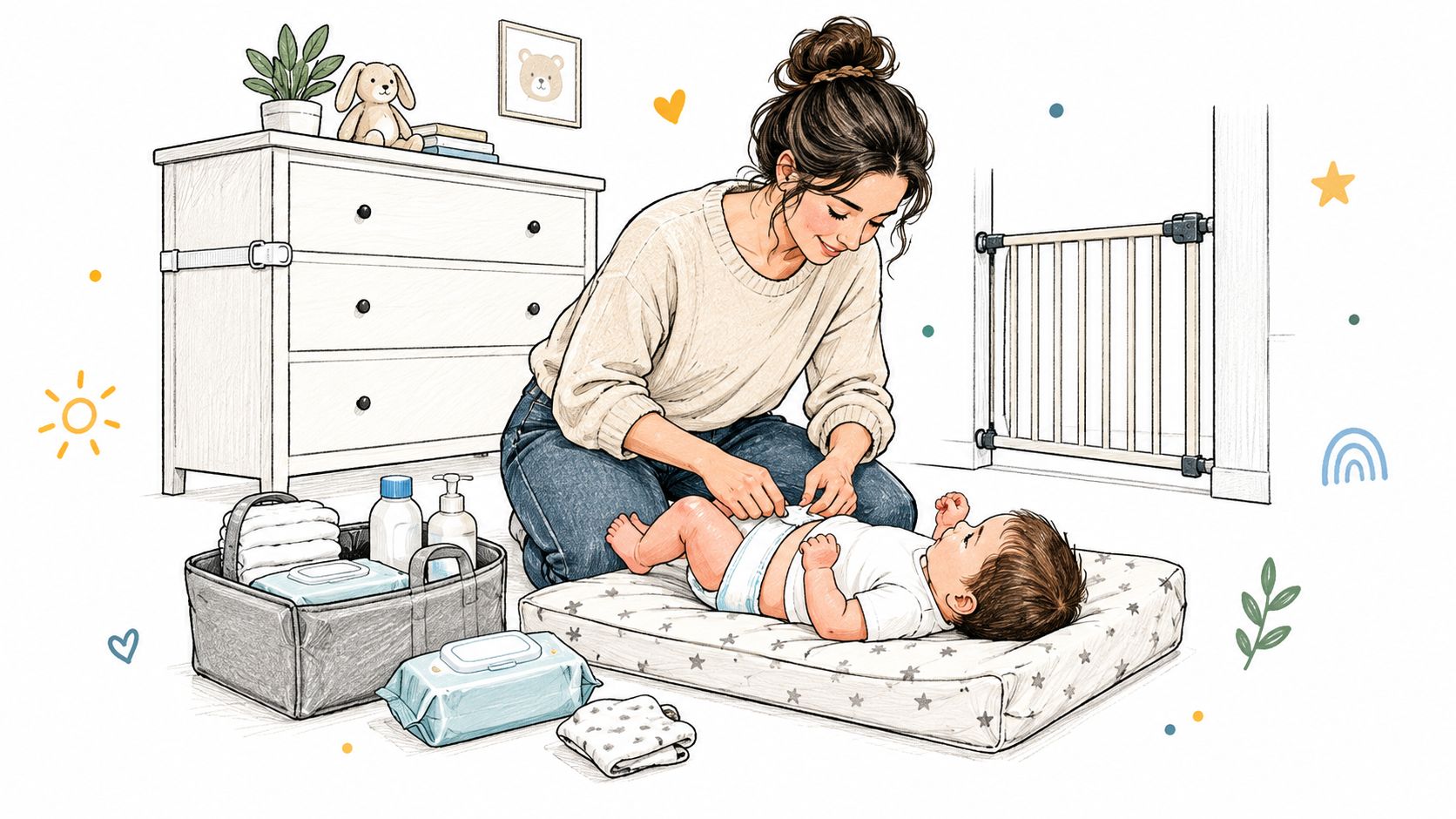
The first roll rarely arrives with warning. A baby who has never moved on the changing table picks the one morning you turn toward the wipes, and suddenly your whole safety model changes. Assume mobility arrives earlier than expected. Keep one hand on your baby during every diaper change, place all supplies within reach before you start, or skip the raised surface entirely and use a changing pad on the floor.
Beds and sofas create the same trap. They feel soft and contained, but a wiggling newborn can work toward an edge faster than you'd predict, and soft adult bedding adds a separate suffocation concern. Put your baby down in the crib, bassinet, or play yard when you need free hands. It's less convenient for thirty seconds, and it's safer every single time.
Anchor, Gate, and Lower Before Each New Skill
- Anchor tall furniture: Strap dressers, bookcases, and TVs to wall studs. The CPSC Anchor It! campaign exists because tip-overs injure children who pull drawers out and climb.
- Gate stairs correctly: Use hardware-mounted gates at the top of stairs. Pressure-mounted gates can work at the bottom or between rooms, but they aren't the strongest option at a stair opening.
- Lower the crib mattress early: Move it down as soon as your baby pushes up strongly or pulls toward standing, and keep toys or bumpers out that could serve as climbing steps.
Fatigue changes fall risk too. An exhausted caregiver carrying a baby on stairs while holding laundry, a phone, and a bottle has no free hand for the rail. Make two trips. The CDC's guidance on sleeping safely and avoiding unsafe sleep situations reinforces the broader point behind this item. Guarding your baby includes guarding your own capacity, because rushed, overtired handling is where preventable accidents cluster.
6. Poison and Medication Storage
Your newborn can't open a cabinet today, but visitors, older children, and your own one-handed routines create exposure paths right now. Medication sits on nightstands, hand sanitizer lives in open bags, and cleaning spray stays beside the sink. Move poisons before mobility forces the issue, because child-resistant caps are a delay mechanism, not a guarantee. Locked and out of sight beats high and hopefully forgotten.
Store all medications, vitamins, cosmetics, detergents, and cleaners in a locked cabinet. Keep products in original labeled containers so nobody mistakes a decanted liquid for something safe, and measure doses only with the tool that came with the medicine. Don't give medicine in the dark, while holding a crying baby, or mid-conversation. Those are exactly the conditions where a dose gets repeated because two adults each think the other hasn't given it yet.
Products That Deserve Extra Respect
Laundry detergent pods caused serious injuries in young children and prompted packaging redesigns and stronger warnings from manufacturers and regulators. Their candy-like appearance is the problem, so never store them in open decorative containers. The same caution applies to gummy vitamins, nicotine products, cannabis edibles, and any medication that looks or tastes like a treat. Don't call medicine candy to encourage cooperation. That shortcut teaches the wrong association.
- Save Poison Help now: Program 1-800-222-1222 in the U.S. and your local emergency number into every caregiver's phone.
- Log shared doses: Write time, medication, and amount on a shared note so a partner doesn't duplicate a dose overnight.
- Treat button batteries as urgent: If you suspect ingestion, call immediately, because severe injury can develop within hours.
- Control visitor bags: Ask guests to keep purses with medication closed and on a high hook or counter.
Storage test: Open every cabinet and bag at knee height. If you'd panic seeing it in your baby's mouth, it doesn't belong there, even for one afternoon.
Poison control centers help families assess exposures and can reduce unnecessary emergency visits, but they work best when you call fast. Save the number before you need it, not during the scare.
7. Fire, Burn, and Hot-Liquid Safety
Burns are the safety item parents most often underestimate because the hazards look like normal adult life. Coffee while holding the baby. Cooking with her in a carrier. Bath water checked quickly with fingertips that tolerate heat better than thin newborn skin does. Each habit feels manageable right up until a startle, a spill, or a reach you didn't expect.
Start with detection and escape, because smoke gives you very little decision time. Test smoke alarms monthly, replace units that are more than 10 years old, and install carbon monoxide detectors where your local code and manufacturer guidance direct. Many fire departments run free alarm installation or replacement programs, so cost shouldn't delay this step. Build a family escape plan with two exit routes from each room, agree on who grabs the baby, and practice it in daylight before you ever need it at night.
Separate Hot Liquids From Baby Handling
- Don't carry both: Put the baby in the crib or play yard before carrying coffee, tea, soup, or a hot pan across the room.
- Cook on back burners: Turn pot handles inward, keep cords from kettles and slow cookers out of reach, and create a no-baby zone near the stove.
- Check bath water properly: Test with your wrist or elbow, not just your hand, because those areas judge heat more like your baby's skin will feel it.
- Keep an extinguisher ready: Store one in the kitchen, check its gauge, and learn PASS, meaning Pull, Aim, Squeeze, Sweep.
Scald prevention also includes your water heater setting. Many hospitals and safety groups recommend lowering it to reduce tap-water burn risk in young children, and your pediatrician or plumber can confirm the right setting for your home. Check space heaters, hair tools, irons, and bottle warmers with the same mindset. If it heats up, it needs distance, a stable surface, and a cord your baby's household can't pull down later.
7-Point Newborn Safety Checklist Comparison
| Safety Measure | 🔄 Implementation Complexity | ⚡ Resource Requirements | ⭐ Key Protection | 📊 Expected Outcome | 💡 Ideal Use Case |
|---|---|---|---|---|---|
| Safe Sleep Environment (ABCs) | Low; consistent habits and a clear sleep space | Low; safety-standard crib, bassinet, or play yard | Reduces sleep-related suffocation and SUID risk | Safer sleep for every nap and nighttime sleep | Place baby alone, on their back, on a firm, flat surface; room-share without bed-sharing |
| Properly Installed Car Seat | Moderate to high; installation and fit require careful checks | Age- and size-appropriate seat; certified technician support can be free | Helps protect the baby's head, neck, and spine in a crash | Improved protection during vehicle travel | Use a rear-facing seat in the back seat, following both manuals |
| Bath and Water Safety | Low; requires constant, hands-on attention | Low; shallow water, prepared supplies, optional thermometer | Prevents drowning and helps avoid scalds | Safer bathing and reduced water-related risk | Keep a hand on the baby and gather supplies before bath time |
| Choking Hazard Prevention | Moderate; ongoing checks of food, toys, and surroundings | Low; safe food preparation and optional first-aid training | Reduces exposure to choking hazards and supports emergency response | Fewer preventable hazards; caregivers better prepared to act | Use age-appropriate foods and toys; supervise meals and learn infant first aid |
| Fall and Furniture Safety | Moderate; some fixtures require correct installation | Safety gates, furniture anchors, and window guards as needed | Helps prevent falls, tip-overs, and related injuries | Safer home as the baby begins rolling, crawling, and climbing | Anchor furniture and TVs; use hardware-mounted gates at the top of stairs |
| Poison and Medication Storage | Low to moderate; storage habits and medication checks need consistency | Locked or elevated storage; keep emergency contact details accessible | Limits access to medicines and household chemicals | Reduced risk of accidental ingestion and faster access to expert advice | Store products in original containers, out of reach or locked; save the Poison Help number in the U.S. |
| Fire, Burn, and Hot-Liquid Safety | Moderate; requires alarms, maintenance, and safe routines | Smoke and CO alarms, protective gates, and regular testing | Helps detect fires and CO; reduces burn and scald hazards | Earlier warnings and fewer preventable burn risks | Test alarms monthly, keep hot items away from baby, and set water heater to 120°F (49°C) or lower |
Make Safety a Shared Responsibility
Print this checklist for new moms to stay guarded with the baby and put it where care happens, near the crib, changing area, and front door. Review it with your partner, grandparents, and any regular visitor who will hold, feed, or put your baby down. Shared rules only protect your baby if every caregiver follows the same version. The grandparent who means well but props a bottle, shares a sofa nap, or adds a soft blanket can undo a careful setup in one visit.
Treat the checklist as a repeatable quality tool, not a memory test. A children's hospital safe sleep adherence intervention raised adherence from 70.8% to 94.7% using AAP-based interventions and weekly process monitoring. Steal that logic for home use. Convert guidance into observable binary checks you can run in seconds, such as baby supine, approved firm surface, separate sleep space, no loose bedding, and caregiver awake during feeding.
Set Visitor Rules Before Anyone Arrives
Guarded doesn't have to mean isolated, but it does mean explicit. Guidance highlighted in Henry Ford Health's advice on meeting a newborn includes symptom-free visitors, hand hygiene, no kissing, masks, and updated Tdap vaccination. Use a tiered approach that fits your baby's health. Postpone visits for fever, respiratory symptoms, vomiting, diarrhea, or active cold sores, require handwashing and no face kissing, and ask frequent caregivers about influenza, COVID-19, and Tdap status.
For premature, medically fragile, or immunocompromised babies, ask your pediatrician what's appropriate instead of negotiating case by case at the door. A short script protects relationships better than improvisation. Try saying you're following your pediatrician's guidance, visits are brief for now, and you'd love help with food or laundry while the baby sleeps. Support doesn't require unrestricted holding.
Plan for Fatigue and Escalate Early
Your own exhaustion belongs on the safety plan. Identify who can take a protected sleep shift, keep the bassinet within reach for post-feed transfers, and give yourself permission to place a crying baby safely in the bare crib and step away briefly when you're overwhelmed. That's not failure. That's prevention. Excessive vigilance without respite undermines the clear decision-making your baby needs from you, so normalize asking for help before you're at the edge.
Revisit the whole setup whenever your baby gains a skill, a new caregiver joins, furniture moves, or you travel to another home. Safety expires as development advances. If a practice feels impossible to maintain, ask your baby's pediatrician or a qualified safety professional for an alternative instead of skipping it.
Know your escalation thresholds in advance. Seek urgent help for breathing difficulty, blue or gray coloration, unresponsiveness, inability to awaken, serious injury, suspected poisoning, or signs of severe dehydration. Contact your clinician promptly for fever in a young infant, feeding problems, or behavior that feels wrong. Trust that instinct and call. A checklist supports your judgment, and it never replaces qualified newborn assessment or emergency care.
Keep your family's sleep checks, visitor rules, emergency contacts, and caregiver handoffs in one place so nobody's guessing during a night feed or a busy homecoming. Visit meetalma.app to turn this newborn safety checklist into a shared routine your partner, grandparents, and sitters can follow.